Episode Transcript
[00:00:02] Hey everyone, welcome to the Hunker Down Guide hurricane Preparedness podcast.
[00:00:09] I'm your host, Jamie Robe. I'm the founder of this channel and I also am someone who has gone through many hurricanes and tropical storms here in Florida. So I'm trying to, in this episode, trying to go over one of the most important things that you can have in advance and that is water, safe drinking water.
[00:00:34] And we're going to go through some of the basics here real quickly and hopefully get you started on, on getting a supply in the, in a low cost way.
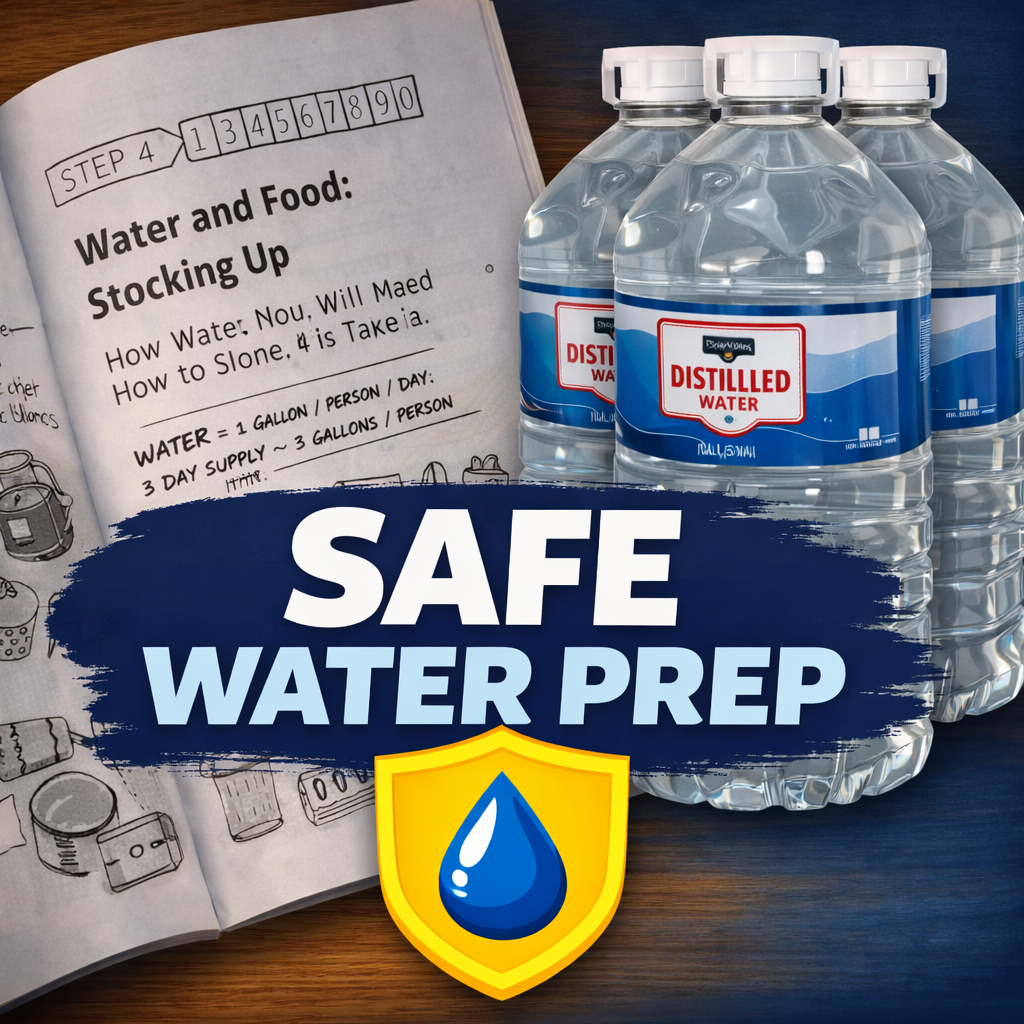
[00:00:45] And to get started with that, we're going to take a look at some information, general information about water. This happens to be in. If you're, if you have my book Day Before Disaster, you can look at page 63 and we have about five or six pages on water.
[00:01:09] Believe it or not, it's a very important topic. Having gone through this myself many times, you really need to make sure you have this locked down for yourself.
[00:01:20] But anyway, some of the fun facts about water is, well, you don't think about this because usually you're just holding a glass of water or whatever, but water is super heavy. Okay, now we're going to go through this, a little more detail here, but a three day supply of water for one person would be three gallons. So it's basically a gallon a day per person.
[00:01:48] And that is three gallons is equal to 25 pounds, which is, which is basically two bowling balls. So if you've ever gone bowling and you think about having to carry around two bowling balls, that's your three day, one person supply of water.
[00:02:08] So that said, let's talk about maybe the reason why you need to have water. Cause you're thinking, well, it's going to be raining, there's lots of water everywhere.
[00:02:24] You know, you've got your waters coming through your, your pipes in your house.
[00:02:29] Well, number one, there's a couple of ways your water can get compromised. Let's assume you're connected to a city or county municipal water supply, it's all always purified, etc. Etc.
[00:02:43] So you normally don't even think about it.
[00:02:46] But in after a hurricane hits, a lot of times you have massive power outages.
[00:02:52] You may even have power at your house, but they may not have power at the pumping stations or the purification plant.
[00:03:01] Maybe there's pumps pumping drinking water out of the ground in wells, municipal wells.
[00:03:11] There's all different kinds of things that can get affected by electrical outage. And the second that the power goes down at those places, it, if, if they can't keep the pressure up inside the pipes, in, in the, in under the streets and coming to your home. Then you get situations where they will do a boil water order. Okay, so in Milton, in our town in Florida, we had, I think the boil water thing went for like five or six days.
[00:03:45] So again, what they're saying there is you got to drink purified water. Either if you're going to use the water out of the, out of the tap, you've got to boil it, which is its own set of issues in a time when you don't have electricity.
[00:04:02] And so think about, you know, all of a sudden the water, if there's water even coming out of the pipes, it may be tainted. The other thing that can happen is there can be floods and there could be breaks in the pipes. Some the pipes aren't a perfect system anyway.
[00:04:20] And so if they don't keep that pressure up, the groundwater or the ocean water can actually penetrate into the water supply pipes. And that's another way that it gets tainted.
[00:04:31] So you just may not have any pressure coming in to your home or it may be contaminated, potentially contaminated water.
[00:04:39] And the other thing is if you have a well on your own property and you lose your electricity, you have no way to, you know, pressurize that supply tank and get water into your home.
[00:04:52] So we need, obviously we need water for drinking, you need it for cooking, you know, for brushing your teeth and other miscellaneous cleaning type things for yourself.
[00:05:04] And so water is critical.
[00:05:07] So let's, let's take a look. Luckily there are some solutions that aren't too expensive and we're going to go into other things that I cover, you know, in the book, you know, later.
[00:05:22] But we are going to take a look at a video here that I took just the other day when I went over to a dollar store near me. And right now you go there and the shelves are fully stocked with all sorts of really low cost water. A gallon of water right now in 2026 is going for $1.75 in the dollar store. Okay? And again, one gallon is a, is a day's supply for one person. So you're like, wow, I don't drink that much water. But if you cook and you do anything like that, you're going to need that water.
[00:06:06] Basically one of the things to look at is this cost per ounce. Okay? So one gallon is 3.78 liters, but it's, it's also 128 ounces. So fluid ounces, in this case, this $75 per gallon is 1.4 cents per ounce. Now if you go to a different store and that same gallon, it might be a couple of bucks or $253, whatever, then you know, your, your price is going to go up.
[00:06:38] So that's something that we need to, you know, keep track of. I personally really like these one gallon containers and it just ironically, they sell these at the cheapest store here, the dollar store, versus going to Publix or, you know, Whole Foods or something where you're going to pay more for water, there's no doubt. But these are neat because they have this plastic handle thing on the top. Now as, as I said, these three gallons of water, these three plastic containers, you can see that my book laying next to it for size comparison, that they are the same weight as two bowling balls. So I can carry like four of these at a time, two in each hand.
[00:07:25] But I would say, you know, you can to be balanced, you have to carry like one or two of these if you had to go long distance or loading from a car.
[00:07:35] But they're, they're rather heavy. And let's, let's talk a little bit about the, you know, how much we need to have on hand.
[00:07:45] So I'm gonna do a little, a little calculations here so you can see what's going on. But let's see, we need one gallon per person.
[00:07:59] Okay. So that's, you know, since we're talking about A$75 per gallon.
[00:08:10] And again, this is the water that they sell there is distilled, they have spring, they have purified. There's all these different words. Now you can buy fancy water that's really expensive. But distilled or purified or spring water, as long as it's, you know, bottled by a reputable company and it's sealed up, it's gonna, it's gonna be okay for a certain amount of time in that bottle. But let's say we have a three day supply. So we have three days and you know, by a $75, that's gonna be $5.25 for that three day supply. Now three days is your minimum that you want to maintain.
[00:08:49] Now every time we've had a brush with a hurricane and a powerful hurricane here, and I'm talking like sideswiped, where we've lost power, or the direct hit with Milton at a Category 3 storm. Where I was, where I'm located, we were down for six days with no power. So we went through a lot of water and we were able to boil water as well.
[00:09:15] So.
[00:09:16] But we did use, we still had a little bit of reserve left in my pretty vast, you know, supply of bottled water and different kinds of storage that I had. But let's say we want to have a family of four.
[00:09:33] And so we're going to have four times three is 12 gallons that we need to have and that's going to be $21.
[00:09:44] So you know, it starts adding up a little bit. Now if you want to do I think a better strategy in the long haul if you've got the money, do a seven day supply.
[00:09:55] Okay?
[00:09:57] So for one person, seven times a dollar 75 is 12, 25. That's going to have seven gallons of seven bottles like that stored in a closet or something. And then if a family of four that's going to be four times seven and that's 28 gallons and that's going to be about $49.
[00:10:25] Okay.
[00:10:26] So that's going to be, you know, that's what you would need to be able to stay someplace safe and have your own water supply. And so 28 gallons of water is a lot of water, I understand to store. But and also, you know, spending that, that money on the, let's say the, the, you know, in advance you've got about $50 invested for a hurricane season. If assuming you, you need it one time or you don't need it at all during that hurricane season, you know it's, it is an investment. But believe me, when you're in a situation, the alternatives are not very pleasant.
[00:11:19] Obviously you're going to have to get water one way or the other. And if, and if they're, you're lucky enough to have like a, a resource, a drop off point or something where, where the county government or the emergency management is, is delivering, you know, water, I've seen that where that's backed up for miles with car, line of cars and people waiting for hours and you know it. And then you're limited to how much water you can get in, in the line, etc. Etc. So it can be very unpleasant feeling if you don't have that safe water for yourself and your family.
[00:12:01] And let's talk a little bit about a portability, okay? So you might need to be evacuating if you're going to evacuate. Taking, taking a lot of water with you, you know, may be important depending where you're going. If you're going to somebody's like a friend's home or family member, some that's more in a, in a safer area, more inland or something, you still may lose Power because remember, these storms are literally hundreds of miles in diameter sometimes. So the effects of of storm can be pretty wide ranging.
[00:12:38] So you got to think about, you know, yes, you're going to somebody else's place, you might want to bring your water with you to be a good, you know, visitor.
[00:12:49] And the other thing, if you go to a shelter, hopefully they have water there stockpiled. But you know, again, if you want to avoid really bad scenarios, I would try to put a water in the, in your car or whatever and you're trying to get there.
[00:13:07] The other thing is, you know, it's heavy so you don't want to, you know, unnecessarily have to transport like 28 gallons of, of water all over the place.
[00:13:21] But you know, if you're staying in your home, I would suggest storing it in your closet or someplace that that's dark and cool. You do not store your water in the garage. Okay? That's a bad place. You do not want the heat day after day because what is, what it's doing, it's, it's dissolving. The plastic will break down and leach into the water. Now the US D A United States Food and Drug Administration, they estimate that it water in a bottle can last one to two years.
[00:14:01] After that it'll start tasting more plasticky and probably have, you know, chemicals leaching into it.
[00:14:08] So my tips are from practical experience is to always, you know, use, use the water within the year. So let's say you buy a bunch of bottled water, you don't need it for hurricane season, you have a party or whatever, you can use it. You know, you go to picnics, you can use it during the rest of the year and use it up and then resupply the beginning of each year.
[00:14:37] The other strategies with water is, you know, if you open the bottle of water, let's say worst case scenario, hurricane hits, you have no power for a week, you don't have good drinking water coming out of the pipes. So you got to, you know, use your bottled water supply. If you open up a bottle of water, it's, it's, you break the seal on it so bacteria in the air will land into that water.
[00:15:09] And then over time you'll get bacteria and algae and stuff growing in that open, you know, container or the container that you've even closed it later.
[00:15:19] So you want to be careful about how you use the water. You know, I basically keep a water log and then have somebody in charge of that water, you know, and, and kind of ration it out to people.
[00:15:34] So you just don't want people going willy nilly opening up different bottles.
[00:15:39] And that's really the big, you know, tips that I have.
[00:15:44] Again, it is an expense.
[00:15:47] You could probably store that bottle of water for one, one or two years in a closet.
[00:15:53] But you know, I tend to replenish it. You can use it, like I said, at picnics and things like that during the year. Go to the beach, take some of your water supply with you later outside of the hurricane season. So you're, you're cycling through and not keeping stuff that's like five years old.
[00:16:11] And I just want to say that, you know, I have, I have a section in the book about food and water.
[00:16:22] So if you want to take a look at this book, it's Day Before Disaster. It's available on Amazon and of course on our website.
[00:16:30] You know, come on in and you can see the post for this show and ask questions in there.
[00:16:37] You know, it's, it's a community of people that are trying to do hurricane prep. So I hope this helps somebody out there again, don't get caught without water. And we'll get, we'll talk about water later on in the season too. But it's definitely, you know, something that is, you take for granted in our normal day to day. But just shut that, that pipe off, that faucet off in your house and you can't use it anymore and you'll see how critical this item is. So I hope everybody can get prepped up and join us on hunker down guide.com and we'll talk to you soon.